Choosing the Right Hiring Model: Contingency, Priority or Executive Search

Share Article:

Key Takeaways

Hiring Model Guide: How to Choose the Right Search Model for Hiring Success

In today’s competitive talent landscape, choosing the right hiring model has become a strategic imperative for businesses. At the start of 2026, companies face intense talent shortages – 74% of employers globally report struggling to find the skilled workers they need. In sectors like manufacturing and automotive, skills gaps are so severe that a shortage of qualified candidates could leave nearly 1.9 million jobs unfilled within the next decade. With talent in such short supply, hiring the right people – and doing so efficiently – is mission-critical. One key decision that can dramatically impact hiring outcomes is selecting the most appropriate direct hiring model for each role. Using an ill-suited approach can increase the risk of a bad hire (an expensive mistake), whereas choosing the right recruitment model helps set the stage for success.

This article provides an up-to-date guide to understanding and selecting among three common direct hire models: Contingency Search, Priority Search, and Executive Search. We’ll explore what each model entails, when to use them, and provide step-by-step guidance on aligning your choice with your hiring needs.

Understanding Different Hiring Models: Contingency vs. Priority vs. Executive

Direct hire searches typically fall into three tiers, ranging from fast, broad-reach recruiting to high-touch executive search. Each hiring model comes with trade-offs across speed, cost, recruiter commitment, and depth of service. Understanding these differences is the first step in choosing the approach that fits your situation. Below, we break down the three models.

Contingency Search – A Fast and Flexible Hiring Model

Contingency search is a performance-based recruiting approach. The recruiting partner is paid only when a candidate is hired, which makes the model attractive when you want quick market coverage with minimal upfront commitment. Many companies run contingency searches with more than one firm at a time to increase reach, especially when the role requirements are straightforward and the priority is getting interviews moving quickly.

Contingency search works especially well for mid-level, common, or urgent roles where time-to-fill is critical and the requirements are clear. For example, after a customer escalation increases inspection volume, a plant may need to add several direct-hire Quality Technicians across shifts quickly to stabilize checks and documentation. It also fits when a facility needs a Production Supervisor fast to support a line ramp or second-shift launch, and the business is prepared to move quickly through interviews while evaluating a broader pool of candidates.

The benefit is reach and speed. Depending on how the search is run, your team may receive a higher volume of candidates, so a disciplined internal process to evaluate fit, schedule interviews, and make decisions quickly becomes important. Screening rigor varies by partner, so strong intake alignment and consistent candidate vetting are essential to maintain quality while moving fast.

When contingency is a good fit: Choose contingency search when urgency is high, the role is well-defined, and the candidate pool is reasonably broad. It is also useful when you want to gauge compensation expectations and availability in the market without committing to an engaged or retained model.

Priority Search – A Focused Hiring Model for Key Roles

Priority search, often called engaged search, sits between contingency and retained executive search. In this model, the employer typically commits a modest engagement fee to secure dedicated recruiting attention, with the remainder paid upon hire. That commitment changes the operating rhythm of the search. Instead of maximizing volume, the recruiter can spend more time calibrating the profile, targeting specific backgrounds, and delivering a tighter shortlist.

Priority search is a strong option when the role is critical to performance but does not require a full executive search process. In manufacturing and quality, that often includes niche roles where the “must-haves” matter and mis-hires are expensive. A Supplier Quality Engineer who can run APQP and PPAP, lead 8D problem solving, and interface with OEM or Tier 1 customers during escalations is a good example. Another is a Quality Systems Engineer who can strengthen IATF readiness, audit performance, and corrective action discipline. In these cases, you usually need more than resumes. You need real validation of experience, communication skills, and credibility with customers.

Because the recruiter is more embedded, priority search is also better suited to consistent reporting and tighter process management. Many companies use this tier when they want a partner who will run weekly progress updates, adjust the target list as feedback comes in, and protect the candidate experience through a more coordinated outreach strategy.

When priority search is a good fit: Choose priority search when the role is specialized, the candidate pool is narrower, and you want a curated pipeline with stronger screening than a typical contingency search. It also fits when you care about process control and candidate experience, but want a more flexible investment than a retained executive search.

Executive Search – An Exclusive Hiring Model for Senior Leadership

Executive search is a retained hiring model built for senior leadership and high-stakes positions where the cost of a mis-hire is significant. In most retained engagements, the search partner is engaged on an exclusive basis and begins work with an initial upfront payment. From there, the firm runs a structured process that prioritizes precision over volume, including research, targeted outreach, and deeper screening before candidates reach your interview stage.

What sets executive search apart is how it finds candidates. Instead of relying primarily on inbound applicants, retained recruiters proactively identify and approach proven leaders, often people who are not actively applying but would consider the right opportunity. Outreach is handled discreetly, which is especially important for leadership transitions, succession planning, or replacing an incumbent. Candidate evaluation is typically more rigorous as well, with structured interviews, leadership assessment, and thorough referencing to confirm both capability and cultural alignment.

The executive hiring model also provides a high level of partnership and advisory support. Expect your retained search firm to work closely with key stakeholders to align on role requirements, success outcomes, and the leadership profile needed to deliver results. In many cases, they will also support job description refinement, target-market calibration, and compensation guidance based on real-time talent-market feedback. In other words, they operate as strategic talent advisors, not just resume providers.

The trade-off for this level of service is greater investment and a longer, more deliberate process. Retained executive searches are typically priced as a meaningful percentage of first-year compensation and often take longer than contingency or priority searches because sourcing and evaluation are more targeted and thorough. For roles where a “game-changing” hire is needed to drive strategy or a turnaround, such as a plant manager overseeing multiple facilities, a Head of Quality leading compliance and customer confidence, or a CTO driving digital transformation, that additional rigor can pay off by reducing risk and securing the right long-term fit.

When executive search is a good fit: Use executive search for C-suite, VP, Director, and other business-critical leadership roles, especially when confidentiality is required, the candidate pool is limited, or the organization needs a leader who can drive change.

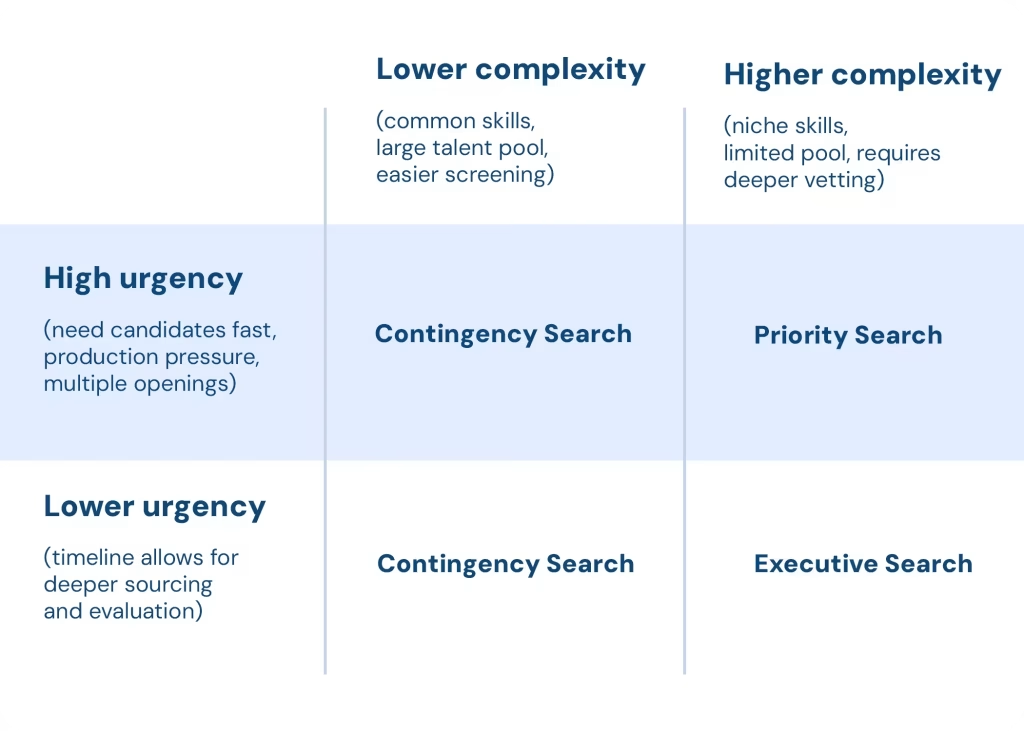
Hiring model decision matrix comparing urgency and role complexity to choose contingency, priority, or executive search.

If the role is confidential, executive-level, or business-critical, Executive Search may be the right fit regardless of urgency.

How to Choose the Right Hiring Model: 5 Key Steps

With a clear understanding of the three models, the next challenge is determining which hiring model is best for your needs. The choice should be guided by the specifics of the role and your organization’s circumstances – there is no one-size-fits-all. To make an informed decision, consider the following steps and factors:

1. Define the Role’s Complexity and Level

Start by evaluating the position you need to fill. Is it a senior executive role or a mid-level position? Does it require hard-to-find skills and a deep talent search, or will a broad outreach suffice? High-complexity leadership roles lean toward an executive search, whereas routine or lower-complexity roles might be handled via contingency search. For roles in between – niche specialists or strategic managers – a priority search could strike the right balance.

2. Assess Urgency and Time-to-Fill

How quickly do you need someone in the seat? If the role is urgent and time-sensitive, a contingency search (or multiple agencies racing to deliver candidates) might deliver results fastest. If you have a bit more time and the priority is getting the best possible candidate rather than the quickest, you might opt for priority or executive search, which typically involves more thorough processes. Be realistic about your timeline; an executive search may take longer, but that can be acceptable for transformative hires.

3. Consider Budget and Resources

Different models have different cost structures. Contingency search comes with no upfront cost, while priority search requires a smaller engagement fee, and executive search demands a substantial retainer. Determine what you are willing and able to invest to get this hire right. Also factor in internal resources: if your HR team can screen a high volume of candidates, you may handle a contingency influx; if not, investing in a retained approach might save effort by yielding a curated shortlist. Remember, a bad hire can cost far more in the long run than the recruiting fee, so weigh the cost of the search against the importance of the role.

4. Evaluate the Need for Partnership and Confidentiality

Ask how much support and discretion you need from your recruiting partner. If you desire a close, consultative partnership – for instance, guidance on role definition, interview design, and employer branding – an engaged or retained model offers that level of service. Additionally, if the search must be confidential (e.g., replacing an executive or launching a new operation), a retained executive search is equipped to handle sensitive searches with discretion. For less sensitive or straightforward hires, a contingency recruiter’s transactional approach may suffice.

5. Prioritize Candidate Experience and Employer Brand

Consider how you want to represent your company in the talent market. Executive and priority searches typically provide a high-touch candidate experience, acting as an extension of your brand to woo top talent. Contingency searches, especially if multiple firms are involved, can become a “race to resumes,” which might result in a less personal process for candidates. If maintaining a premium candidate experience and consistent employer messaging is important for this hire, lean toward a model where the recruiter is more tightly aligned with your team (priority or retained search). On the other hand, if the candidate pool is large and the process is mainly a volume game, this may be less of a concern.

By systematically examining these factors – role complexity, urgency, budget, partnership needs, and candidate experience – you can determine which model aligns best with your situation. For example, if a customer escalation creates an immediate need to add Quality Technicians across shifts, a contingency search can help generate candidates quickly. On the other hand, a confidential search to replace a Quality Director or senior operations leader, especially during a turnaround, typically calls for an executive search approach where discretion, passive outreach, and thorough vetting matter most.

In some cases, you might even use different models for different roles concurrently as part of a broader talent acquisition strategy. The key is to be intentional and strategic in matching the hiring model to the hire. This ensures you allocate resources wisely and attract the caliber of talent your business needs.

MS Companies’ Scalable Direct Hire Approach

MS Companies delivers direct hire through a contingency-based model, with the flexibility to scale the search process based on the role. Whether you need fast candidate flow for high-volume hiring, a curated shortlist for specialized positions, or a confidential approach for leadership hires, we tailor sourcing strategy, screening depth, and reporting cadence to match your timeline and risk level.

Have an urgent or hard-to-fill role and want a tailored search strategy?

More Insights Articles